Custom Landscapes by Design logo
Stone steps through boulders and planting illuminated by visible landscape-lighting fixtures at night

Low-Voltage Lighting for Open Suburban Yards

Parker Landscape Lighting Installation

Lighting on an open Parker lot behaves differently than it does under tree cover. With little canopy to catch it, light carries, so a good plan here is as much about what stays dark as about what gets lit.

  • Low-voltage fixtures selected and aimed for open ground
  • Cable routes and transformer access planned before the yard closes in
  • Free on-site lighting estimates across the Parker area

Get a Parker Lighting Estimate

Tell us which parts of the yard you use after dark and what you would like to see from the house.

Start with the ground you are on

Open Ground Changes What a Fixture Has to Do

Parker sits on rolling grassland and suburban piedmont, with the Cherry Creek riparian corridor running through town and generally less tree cover than the wooded communities to the west. That is a landscape description rather than a rule about any particular lot, but it changes the lighting problem in a way worth naming.

Under a canopy, a stray beam gets caught by trunks and foliage within twenty feet. On open ground it keeps going. Sightlines across and between yards run long, so a fixture that would vanish under cover stays visible from the street, from the neighboring property, or from a trail-side view. The consequence is not that you need fewer fixtures. It is that output, aiming, and shielding carry more of the design than they would somewhere with more to hide behind.

It is worth saying plainly what this is and is not for. Lighting makes a yard easier to understand at night. It does not remove a hazard, it does not make a surface safe, and it is not a security product. We plan it as a way to use the space after dark, and we will not attach promises to it that a light fitting cannot keep.

Three Distances a Lighting Plan Has to Answer

Rather than working through a list of fixture types, we plan by how far the light has to travel. Each distance has a different job, wants a different amount of output, and fails in a different way when it is wrong.

Underfoot: where the surface changes

The closest layer is the one people actually need. Treads, landings, the lip where a patio meets a lawn, the point where a walk narrows or turns. Light here is low, frequent, and quiet, and the aim is to reveal an edge rather than to make a feature of the fixture. Over-lighting this layer is the single most common mistake, because bright points at ankle height sit right in your line of sight.
Middle distance: the house and how you arrive at it

The approach, the door, and the face of the house form one view that people see from a car and from the sidewalk. Several restrained layers read better than one source trying to cover the whole elevation, and the material matters: a pale stucco wall returns far more light than stone or dark siding and needs correspondingly less output pointed at it.

Far edge: the thing that gives the yard depth

One tree, one wall, one substantial bed at the back of the property does more for a nighttime view than a dozen small accents scattered across it. This layer is what stops the yard ending at the patio after dark. It is also where restraint pays most: pick the one or two things worth looking at and leave everything between them alone.

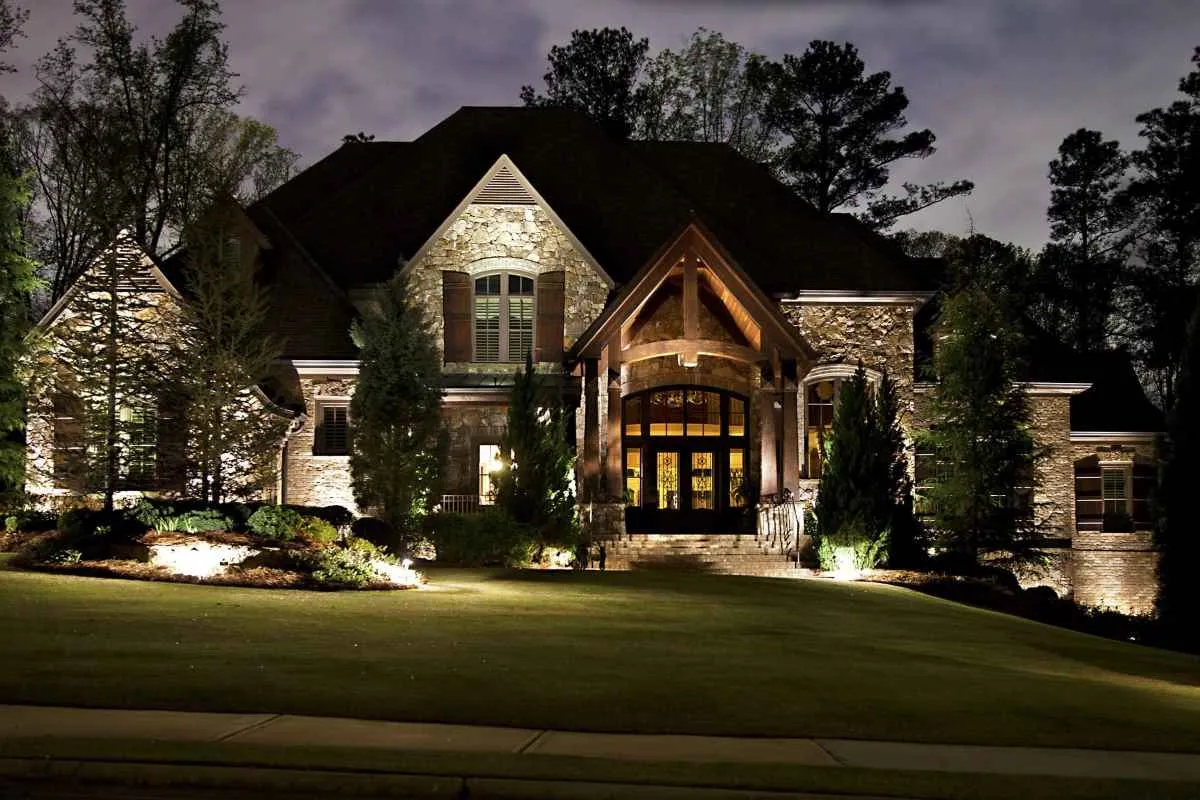
Stone home entry and front landscape illuminated from several directions at night
Several restrained layers across an approach read better than one source trying to cover the whole elevation.
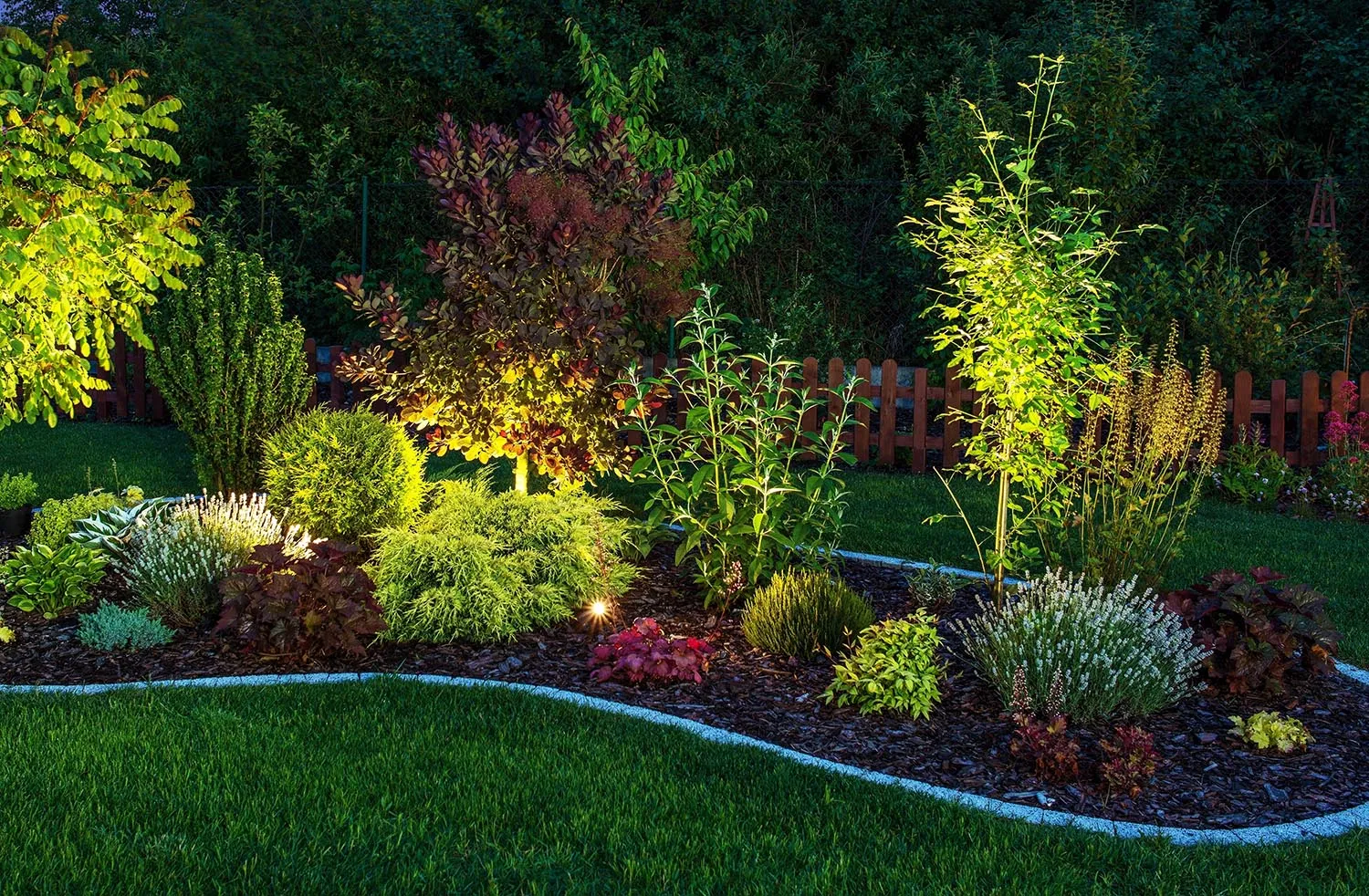
Accent fixtures illuminating trees, shrubs, and perennials in a nighttime planting bed
The dark ground between these pools of light is doing as much work as the lit planting.

Output Is a Decision, Not a Default

The instinct when a yard does not look right at night is to add brightness. Usually the problem is the opposite. A fixture that is too strong for what it is pointed at washes out the surface, throws light past its target, and forces everything else to compete.

Two things set the right output. What the light is landing on, because pale paving and light-colored walls return much more than dark stone, mulch, or foliage. And where the source sits relative to a viewer, because on open ground with long clear sightlines there is nothing to block a fixture you can see directly into. Keeping the source quiet and the lit surface bright is the whole discipline.

Along a boundary, that discipline gets stricter. Fixtures near a property line, an open-space edge, or a trail corridor get aimed back into the yard and shielded so the light does the work you paid for rather than landing where nobody asked for it. It is a courtesy, and it also happens to produce a better result inside your own yard.

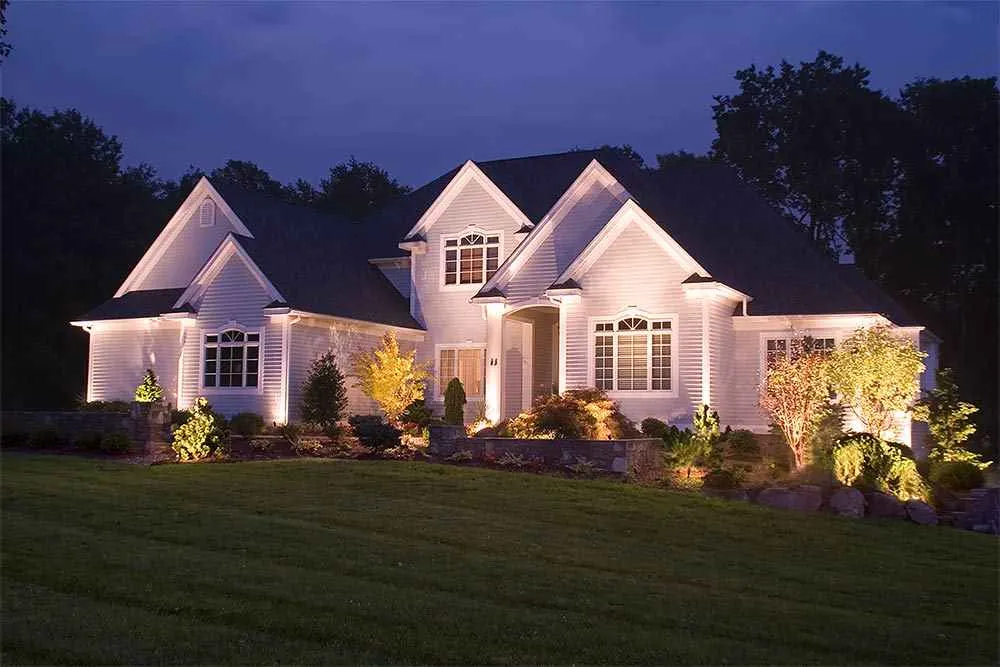
Front entry, trees, shrubs, and a low wall illuminated across a white house facade at night
A pale wall hands most of the light back. The same fixture aimed at dark stone or foliage would disappear.

The Wiring Is the Part That Is Hard to Change Later

Fixtures can be swapped in an afternoon. What runs under the yard cannot, which is why the cable plan deserves more attention than the fixture list.

  1. 01

    Draw the runs while the yard is open

    Cable wants to follow bed lines, wall bases, and anywhere a spade can go later without wrecking something. On a yard still under construction that is a free decision. On a finished one it is a negotiation with everything already planted.

  2. 02

    Sleeve anything that crosses hard surface

    A short length of conduit under a walk, a patio, or a driveway costs almost nothing while the surface is off and is close to impossible to add afterwards. The same applies under an area about to be sodded or turfed.

  3. 03

    Put the transformer somewhere reachable

    It needs a suitable supply, sensible mounting, and enough clearance that someone can actually open it in three years. Tucking it behind a shrub that will be four feet wider by then is a decision you pay for later.

  4. 04

    Aim it at night, not at noon

    Fixtures get positioned in daylight and aimed after dark, because that is the only time you can see what a beam is doing. Expect to walk the yard once with us in the evening and move several fixtures a few degrees.

Where lighting is one element of a larger yard, this is the step that has to be coordinated with everything else going in the ground. Irrigation lines, planting, walls, and paving all compete for the same few inches, and they are all easier to work around while they are still lines on a plan than after they are installed.

The Plan Moves as the Planting Does

A lighting design is aimed at a landscape on one particular evening, and the landscape does not hold still. Almost everything people describe as a lighting fault a few years on turns out to be a plant, a pile of mulch, or a rearranged patio rather than a fixture.

Plants grow into the beam

A shrub that was clear of a fixture in April can be sitting in front of it by August. The symptom is a bright patch of foliage and a dark path, and the fix is usually pruning or a few inches of repositioning rather than more equipment.

Mulch and rock migrate

Ground-level fixtures get gradually buried by top-ups, wind, and runoff. Clearing the lens and re-setting the height takes minutes and restores most of what people assume is a failing fixture.

The yard changes what it needs

A new bed, a removed tree, a rearranged patio, or furniture in a different place all move where light should land. Re-aiming after a change is normal maintenance, not a redesign.

What moves a lighting estimate is the number of areas being lit, how far the cable has to run to reach them, how much of that run crosses finished surface, the transformer location and supply, and the evening aiming visit. All of that is read off the yard rather than taken from a package, and the plan is deliberately built so it can be extended later without redoing what is already buried.

Landscape Lighting Questions in Parker

Will the lighting spill onto the street or the property next door?

That is the question worth asking on an open lot, and it is the reason we spend so much time on aiming and shielding. With little tree cover to absorb stray light, a badly aimed fixture is visible from a long way off. We keep sources out of the common sightlines, aim boundary fixtures back into the yard rather than across it, and use the lowest output that does the job. If the property backs onto open space or a trail corridor, that constraint gets tighter, not looser.

How much of the yard should stay dark?

More than most people expect. Contrast is what makes a lit landscape read as depth instead of a flat wash, and the dark areas are doing as much work as the lit ones. A plan that puts a fixture on every plant flattens the whole yard and, oddly, makes it harder to see, because your eyes adapt to the brightest thing in view. We would rather light three things well and leave the rest to fall away.

Can lighting be added to a yard that is already finished?

Yes, and it is the more common version of this job. The constraint is routing rather than fixtures: cable has to reach without trenching through a patio or a lawn that just got established. In practice runs follow bed edges, wall bases, and existing soft ground, which usually reaches most of what matters. Where a route genuinely has to cross a hard surface, we will tell you what that involves before you decide the fixture is worth it.

Does landscape lighting make a property safer?

It makes a yard easier to read after dark, which is a real and worthwhile thing. It is not a security system and we are not going to sell it as one, and it does not remove a hazard: a step that is awkward in daylight is still awkward when it is lit. What good lighting does is show you where a surface changes, where a route turns, and where the edge of something is, so you are not guessing. Treat that as the benefit and you will be happy with the result.

What does low voltage actually mean, and is an electrician involved?

The fixtures and the cable in the yard run at low voltage from a transformer, which is what makes the buried runs and the fixtures themselves landscape work rather than building work. The transformer still needs a suitable supply, and any line-voltage supply work is handled by the appropriate qualified trade rather than by us. We plan, install, and aim the low-voltage system and coordinate that connection; we do not claim electrical credentials we do not hold.

What happens to the fixtures under snow?

Mostly nothing, as long as they are not being shoveled onto. The two things that cause trouble are snow piled from a walk or drive burying a ground-level fixture and meltwater refreezing around a lens. Both are avoidable at the design stage by keeping fixtures out of the places snow gets pushed to, which is one more reason we would rather set positions before the first winter than after it.

Light the Parker Yard You Already Have

Walk us through where you go after dark, what you would like to see from indoors, and where the yard currently disappears. We will plan the layers and the routes around it.