Can the source stay out of the sightline?
A useful path or step fixture illuminates the surface without making the lamp the brightest object in the view. Housing, shield, mounting height, and approach angle all contribute.


The Night-Sky Standard Changes What a Fixture Must Do
Published guidance from the Sterling Ranch Community Authority Board describes a dark-sky commitment for exterior lighting. That makes shielding, beam direction, and spill more than aesthetic preferences: the plan has to put light on the intended surface while keeping the source, glare, and boundary spill under control.
Tell us which routes and outdoor areas need to remain readable after dark.
The CAB's words, accurately bounded
Two live CAB one-sheets describe Sterling Ranch as a “Dark Sky neighborhood” and a “Dark Sky compliant neighborhood,” and state a commitment to outdoor-lighting standards that support a comfortable nighttime environment while protecting the view of the sky. Those are the CAB's descriptions. They are not evidence of certification by the International Dark-Sky Association or DarkSky International, and we do not turn them into that claim.
The exterior-replacement sheet points to fixtures with the IDA Fixture Seal of Approval or to a fully shielded bulb with its cone aimed down to reduce skyglow, glare, and light trespass. The sheets are undated, say they are not all-inclusive, and can be amended. Current guidance and property-specific requirements are therefore checked before a fixture schedule is final.
A useful path or step fixture illuminates the surface without making the lamp the brightest object in the view. Housing, shield, mounting height, and approach angle all contribute.
The CAB guidance points toward fully shielded fixtures with the cone directed down to reduce skyglow, glare, and light trespass. Aiming is checked at the boundary as well as at the feature.
Unlit space preserves contrast and keeps the design from flattening the yard. Any documented Transition Zone is treated as an exclusion, not as another edge to accent.
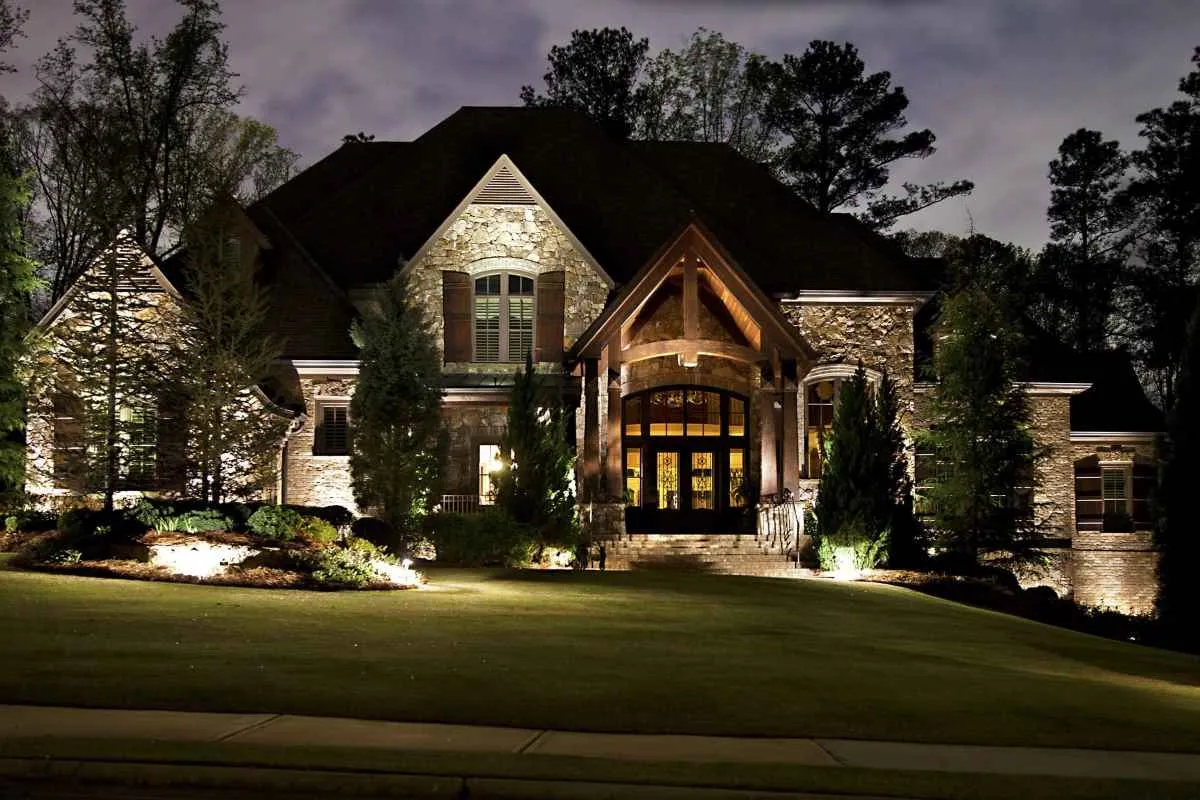
Light the route, not the whole scene
A useful nighttime plan starts with movement and use: the first tread, a change in grade, the turn toward the door, the patio edge. It adds a restrained distant layer only where that view can be contained. Dark space between those moments gives the eye contrast and keeps the source from competing with the surface.
In the recorded declaration dated 28 September 2015, unreasonably bright light and unreasonable glare are separately prohibited. CAB one-sheets also say exterior lights must not create a nuisance or hazard. We design to those standards without promising security or claiming that illumination eliminates every hazard.
Three reasons, three different light levels
Movement
Light lands where a route begins, changes direction, narrows, or changes elevation. The purpose is legibility, never a promise that every hazard has been eliminated.
Use
Low-output layers can define the transition between a gathering area and the route home without flooding the entire patio. Fire features and architectural light are coordinated but remain separate systems.
Depth
A tree, wall, or planting composition may anchor the view when it can be lit without sending glare or spill beyond the intended area. More fixtures are not automatically a better plan.
The beam has an edge
Shielding controls what leaves the fixture; aiming controls where the remaining light lands. We look from the normal walking route, from the feature being accented, and from the boundary. A selected plant or wall can receive light while the beam still stops before a neighboring window or the sky.
For lots adjacent to open space, the CAB initiatives adopted 26 August 2020 describe a Transition Zone that excludes lighting. That restriction belongs to a documented lot condition, not to every property. Whether a lot has a zone, where it lies, and what the current DRC guidance requires are confirmed for the address.
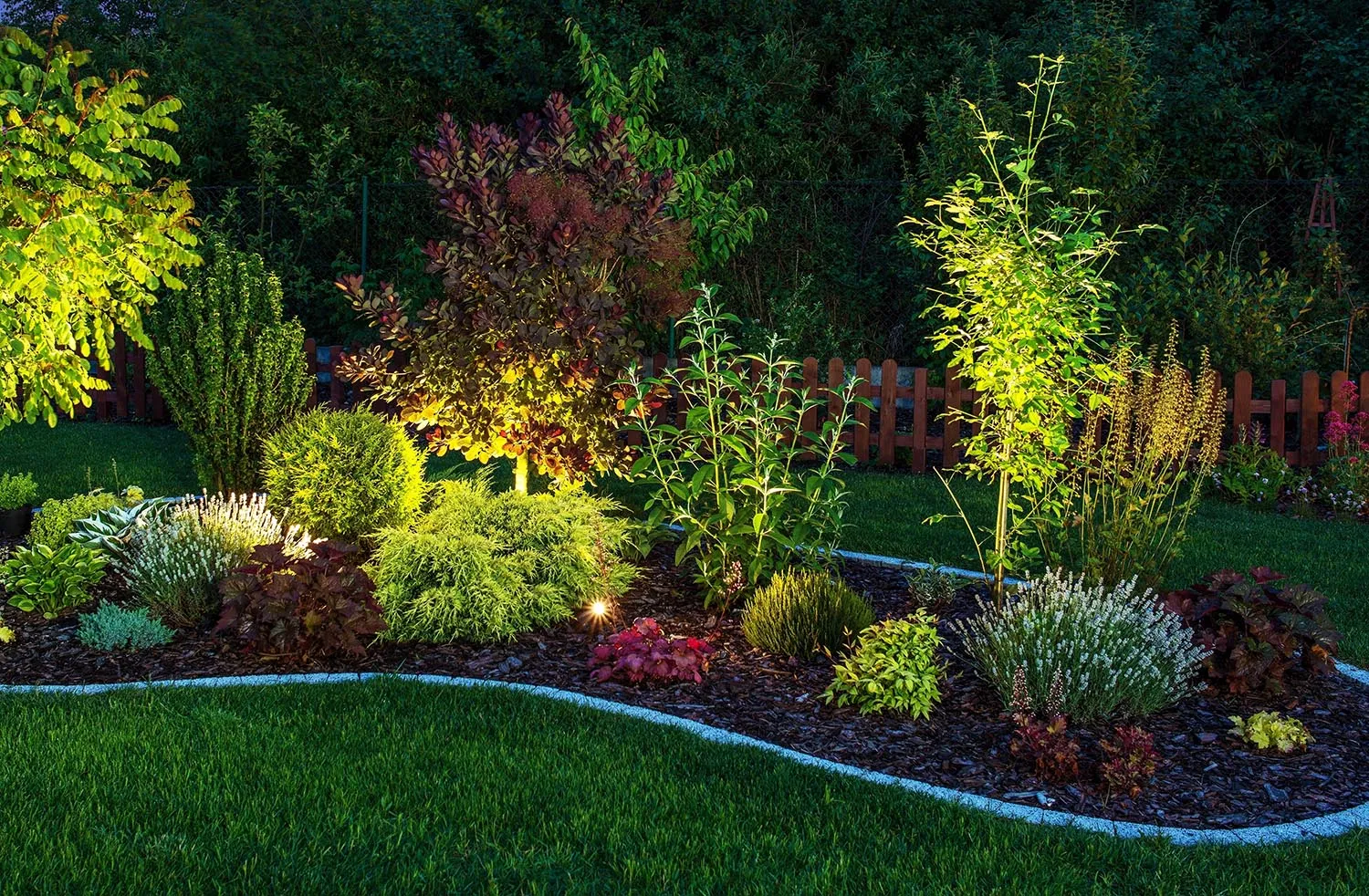
Do the buried work while the route is open
Cable routes are easiest to protect before a patio, walk, retaining edge, decorative rock, or dense planting closes the trench. Planning sleeves with the hardscape preserves a serviceable path without cutting finished work later. Transformer access, voltage drop, fixture locations, and future maintenance still have to make sense as one system.
The CAB and DRC govern the community-review layer. Government electrical treatment for the actual scope is a separate question, and the evidence for this page does not verify a permit rule or exemption. We confirm what applies to the project instead of publishing an unsupported threshold.
Community review is not a government permit
DRC approval is required to modify or add exterior lighting under the CAB one-sheets, while the recorded declaration names exterior light fixtures as Improvements and requires prior written approval before construction. A submittal can show fixture type, location, shielding, direction, affected surfaces, cable path, and the relationship to boundaries and any documented Transition Zone.
The current documents, village, filing, builder product, lot condition, and review requirements are confirmed for the property. We prepare the plan and make space for review in the schedule; the DRC decides the application, and no outcome or timeline is promised.
The CAB's published one-sheets describe Sterling Ranch as a Dark Sky neighborhood and a Dark Sky compliant neighborhood, and say the community is committed to outdoor-lighting standards that preserve a comfortable night environment and the view of the sky. We attribute that language to the CAB; we do not claim that Sterling Ranch is certified by DarkSky International. For a plan, the practical direction is controlled output, shielding, downward aiming, and restraint.
For modifications or additions to exterior lighting, the CAB one-sheets state that Design Review Committee approval is required. The recorded declaration also names exterior light fixtures as Improvements requiring prior written approval. Current documents and property-specific requirements are confirmed before a submittal is prepared. Approval and timing belong to the DRC and are not promised.
Fixture selection begins with shielding and beam shape, then mounting position and aiming are tested after dark from the lit surface, the normal approach, and the edge of the property. The CAB guidance calls for a fully shielded bulb with its cone pointed down to reduce light trespass, and its rear-patio sheet says light cannot project beyond property boundaries. We use that boundary principle without transferring the sheet's string-light numbers to landscape fixtures.
Open-space-adjacent lots are the documented context for the Transition Zone described in the CAB Water Demand Management Initiatives adopted 26 August 2020, which exclude lighting within that zone. That does not establish that any particular property has such a zone. Open-space adjacency, the zone's applicability and location, and the current DRC requirements are confirmed from the property documents before fixtures or cable routes are drawn.
No automatic transfer is appropriate. The rear-patio document's numeric limits concern string lights over patios and decks, a different fixture class. This page uses only the broader exterior-lighting principles that the CAB also publishes: DRC review, visual comfort, energy efficiency, shielding, downward aiming, glare control, and keeping light within the property. It does not apply the string-light lumen, wattage, color-temperature, or shutoff figures to low-voltage landscape lighting.
Before paving, wall caps, rock, and dense planting close the route. Sleeves can preserve a path under future hardscape while transformers, cable runs, and fixture access remain serviceable. Electrical permitting treatment has not been verified in the evidence for this page, so no permit exemption or requirement is stated here; the applicable government requirement is confirmed for the actual scope.
Walk the routes after dark during an on-site estimate, identify the surfaces worth lighting, map boundaries and any property-specific exclusions, and prepare a fixture plan for review.